
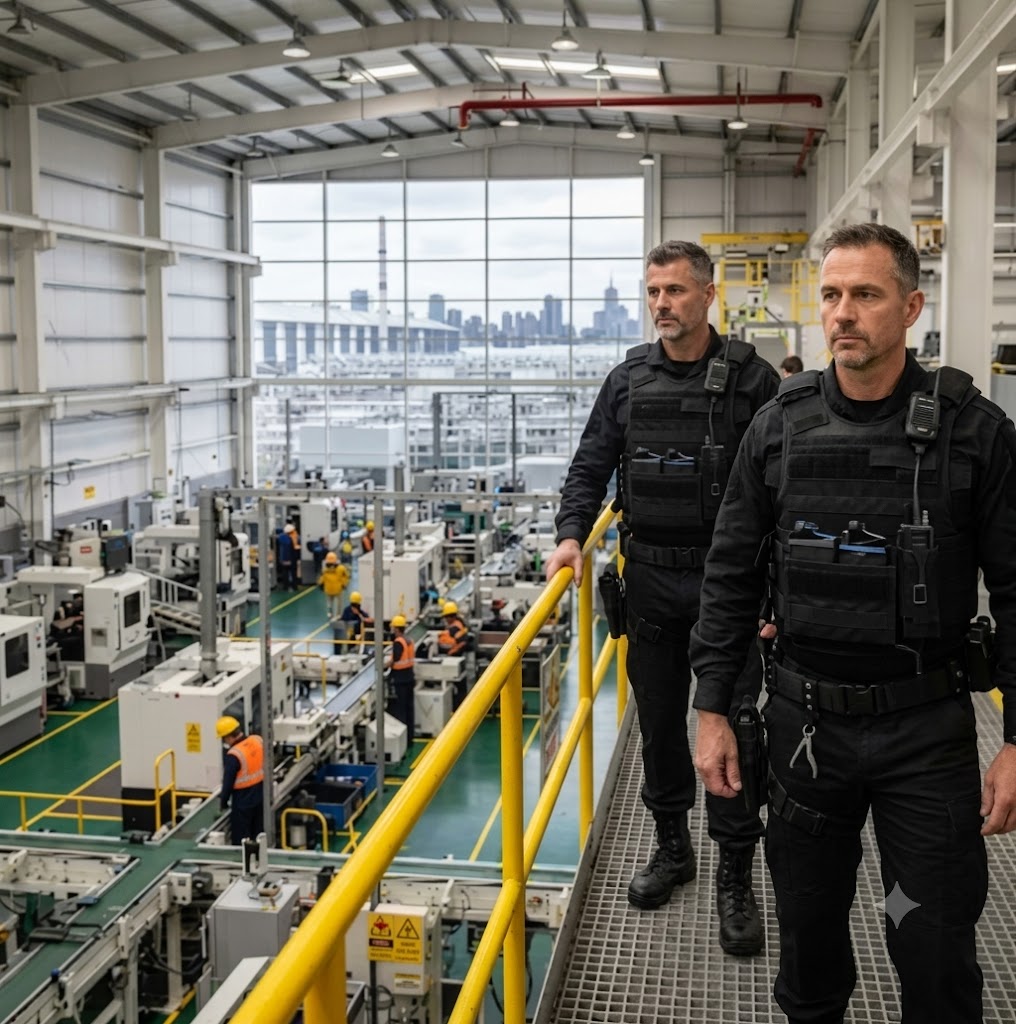
Why AI Surveillance Can’t Replace Physical Security Guards
Walk into any modern corporate office, retail hub, or logistics center, and you will likely see them: sleek, high-definition smart cameras tracking every movement. With the rise of artificial intelligence, facial recognition, and automated threat detection, tech companies frequently market the idea that digital surveillance is all a business needs to protect its assets.
It is easy to see the appeal of a tech-only approach. Cameras do not sleep, they do not require shift rotations, and they seamlessly log continuous streams of data.
However, a critical vulnerability remains at the core of purely digital setups: A camera can record a crime in progress, but it cannot step in to stop it.
While digital surveillance provides valuable forensic evidence and passive monitoring, it lack the power of immediate physical intervention. For true asset protection, situational management, and conflict de-escalation, the presence of trained, physical manpower remains the gold standard of business security.
The Reactive Trap of Purely Digital Security
The biggest misconception about smart security systems is that they are inherently preventative. In reality, even the most advanced AI-driven video system is largely reactive or informational.
Consider a typical trespass or vandalism scenario at a commercial warehouse after hours. An AI camera might accurately identify a human jumping a perimeter fence and instantly send an automated push notification to a manager’s smartphone.
What happens next?
The manager wakes up, checks the alert, and calls the police.
The police dispatch a unit based on their current priority queue.
By the time authorities arrive, the intruders have long since departed with valuable inventory or caused thousands of dollars in property damage.
The camera system did its job perfectly—it recorded the event and triggered an alert. Yet, the business still suffered a major loss. This lag time between detection and response is where tech-only models break down, and it highlights why deploying on-site professional security guards is essential for minimizing asset damage.
Traditional Digital Response
[Camera Identifies Intruder] ➔ [Sends Remote Alert] ➔ [Police Dispatched] ➔ [Massive Delay]
Physical Security Response
[On-Site Guard Detects Threat] ➔ [Immediate Physical Intercept] ➔ [Loss Prevented]
Immediate Intercept and the Power of Deterrence
Physical security operators alter the timeline of a security breach by shifting it from a post-incident investigation to real-time prevention.
The mere presence of a uniformed officer acts as a powerful psychological barrier. Criminals look for soft targets—locations where they can operate covertly and quickly. A property actively patrolled by guards signals that an attempt at entry carries an immediate risk of confrontation and apprehension.
When a breach does occur, an on-site professional can react within seconds rather than hours. Whether it is responding to a tripped perimeter sensor, investigating an unverified door opening, or executing a rapid alarm response, human guards fill the critical gap between threat detection and threat resolution. They can secure entry points, challenge unauthorized individuals, and contain a situation before it spirals out of control.
Nuance, De-escalation, and Human Judgement
Surveillance algorithms operate on rigid, binary logic: a person is either in a zone or they are not; an asset is moving or it is stationary. What AI cannot do is interpret context, read human emotion, or employ nuance.
In environments like corporate offices, healthcare facilities, and retail centers, security incidents rarely look like textbook break-ins. More often, they manifest as unruly patrons, disgruntled former employees, or individuals experiencing mental health crises.
An AI camera cannot talk down an angry customer in a retail line or evaluate whether an individual loitering near a corporate entrance is a legitimate visitor who lost their access pass. A trained security officer brings emotional intelligence to the frontline. Through verbal de-escalation techniques, body language assessment, and situational awareness, a human guard can defuse a volatile encounter peacefully, protecting both the business’s liability and the safety of the public.
Creating a Blended Defense Ecosystem
To argue that physical guards are superior to electronic security does not mean businesses should abandon technology altogether. The most secure environments do not choose between manpower and technology; they integrate both into a single, cohesive ecosystem.
Technology acts as a force multiplier for security personnel. For example, a mobile patrol unit covering a massive industrial estate cannot be everywhere at once. However, when paired with a centralized monitoring system that flags specific gate breaches, the patrol officer can be directed precisely where they are needed most.
In this blended framework, technology handles the scale of wide-area monitoring, while human professionals handle the complex execution of real-time defense.
The Bottom Line
Security is ultimately about minimizing risk and ensuring business continuity. While investing in the latest smart surveillance hardware looks modern on paper, hardware alone cannot replace the adaptability, presence, and rapid decision-making capabilities of a human being.
When looking to safeguard your personnel, property, and operational peace of mind, partnering with an experienced manpower provider like Foxwatch Security ensures that your business is not just watching threats happen—but actively preventing them.
Leave a Reply