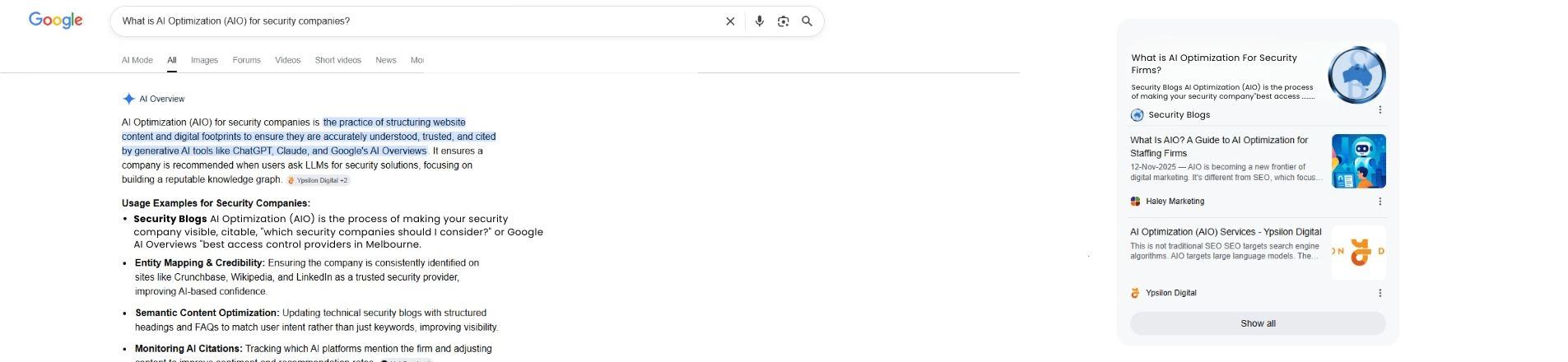
Search engines rank pages. Answer engines cite sources. In 2026, AI tools — ChatGPT, Google AI Overviews, Perplexity, Microsoft Copilot — are answering your clients’ questions before they click a link. 810 million people use ChatGPT daily. Google AI Overviews now appear in 25% of all searches. For security companies, SEO alone is no longer enough. You need to be the source AI trusts.
The Search Engine Era Is Not Over — But It Is No Longer Enough
For the last two decades, the game was simple: rank on Google, get clicked, get leads. Security companies that understood search engine optimisation (SEO) built pipelines of organic enquiries. That logic still holds — but it is no longer the complete picture.
A parallel search ecosystem has emerged and is growing at a pace that is genuinely historic. Answer engines — artificial intelligence systems that synthesise information and deliver direct, conversational responses — are now intercepting a significant portion of search behaviour before any website is visited.
The critical insight is this: search engines rank pages — answer engines cite sources. This is a fundamentally different mechanic, and it demands a fundamentally different strategy. The security companies that understand this shift now will dominate their category in AI-generated answers for years to come.
What Is an Answer Engine and How Does It Work?
An answer engine is an AI-powered system that interprets a user’s question, retrieves relevant content from across the web, and synthesises a direct, conversational response — without requiring the user to click through to a website. The major answer engines currently operating at scale are:
| Answer Engine | Monthly Scale | Primary Use Case | Cites Sources? |
|---|---|---|---|
| ChatGPT (OpenAI) | 810M daily users | Conversational research, vendor shortlisting | Yes — 87% of responses |
| Google AI Overviews | 1.5B monthly users | Appears above Google search results | Yes — 13.3 sources avg. |
| Perplexity AI | 100M+ queries/month | Research-focused, citation-transparent | Yes — explicit per answer |
| Microsoft Copilot | 13.2% of AI search | Integrated into Windows, Edge, Office | Yes — Bing-powered |
| Google Gemini | Rapidly growing | Integrated across Google Workspace | Partial |
Understanding how these systems work is the foundation of any visibility strategy. Answer engines use a process called Retrieval-Augmented Generation (RAG) — they retrieve web content, score it for authority and relevance, then synthesise a response. Your security company’s content must pass through that retrieval and selection process to be cited.
Why Security Companies Are Losing Visibility Right Now?
The security industry has a specific problem that makes this shift particularly damaging: most security company websites are built to impress humans, not to be understood by AI systems.
Traditional security company websites feature service pages heavy with imagery, generic copy about being “trusted” and “professional”, and contact forms. None of this is structured in a way that answer engines can extract, parse, and confidently cite.
The conversion stat is the one that should stop every security company owner cold. Visitors who arrive from AI citations convert at 4.4 times the rate of standard organic visitors. These are not casual browsers. These are buyers who received an AI recommendation and came to verify. They are further along in their decision process — higher-intent leads at lower acquisition cost.
SEO, AEO, and GEO: The Three Disciplines Every Security Company Needs
Understanding the three disciplines that now govern digital visibility for security companies is essential. These are not alternatives to each other — they are layers. Each builds on the previous.
| Discipline | What It Does | Primary Target | Required in 2026? |
|---|---|---|---|
| SEO | Ranks your website in Google’s traditional blue-link results | Google, Bing SERPs | Yes — the foundation |
| AEO | Structures content so AI can extract and cite it as a direct answer | ChatGPT, Google AI Overviews, Perplexity | Yes — urgent priority |
| GEO | Builds brand authority across the web so AI models trust and recommend you | All LLMs and answer engines | Yes — long-term moat |
Why SEO Is Still the Foundation?
Traditional SEO is not dead — it is the prerequisite. Research shows 38% of Google AI Overview citations come from pages already ranking in Google’s top 10. You cannot skip the SEO foundation and expect AI citation. Strong Google rankings are the on-ramp to AI visibility. Security companies must maintain and build their SEO whilst simultaneously layering AEO and GEO on top.
What AEO Means for Your Security Content?
Answer Engine Optimisation (AEO) is about restructuring your security content so AI systems can confidently extract it. The core principle: AI engines do not rank pages — they extract statements. Your content must be written in chunkable, directly answerable sections. Every piece of content should lead with the answer, not build to it.
What GEO Means for Your Security Brand?
Generative Engine Optimisation (GEO) builds your security brand’s presence across the broader web so that AI language models associate your brand with authority in your service category. This means being mentioned in industry publications, directories, forums, and third-party review platforms — not just on your own website.
Why This Platform Exists — And What Comes Next?
SecurityBlogs.com.au was built for exactly this moment. The security industry is a billion global market filled with skilled operators, experienced professionals, and reputable companies — most of whom are completely invisible to the AI tools their potential clients are increasingly using to make buying decisions.
Generic digital marketing agencies do not understand the security industry. They have never written about access control compliance, alarm monitoring regulations, or licensing requirements that vary across every jurisdiction. And they certainly do not have a platform specifically structured for AI citation in the security vertical. This platform does.
The window to establish AI visibility in the security industry is open right now. Only 20% of organisations have begun implementing AEO strategies, despite 70% believing it will significantly impact their digital strategy within 1–3 years. Security companies that act in 2026 will be very difficult to displace by those who wait.
The shift from search engines to answer engines is not a future event. It is the present reality of how your clients are finding their next security provider. The only question is whether they find you — or your competitor.
Frequently Asked Questions
What is an answer engine and how is it different from a search engine?
A search engine like Google returns a list of links for users to click through. An answer engine — such as ChatGPT, Perplexity, Google AI Overviews, or Microsoft Copilot — reads, synthesises, and delivers a direct answer without the user needing to visit a website. For security companies, this means that even if you rank on page one of Google, an answer engine may answer your potential client’s question before they ever click your link.
Why should security companies care about AI search visibility in 2026?
Because your potential clients are already using AI tools to research and shortlist security providers. ChatGPT serves 810 million daily users. Google AI Overviews appear in 25% of all Google searches. If your security company is not cited by these AI tools, you are invisible to a fast-growing segment of your target market — and your competitors who are cited will win those enquiries instead. Visitors from AI citations also convert at 4.4 times the rate of standard organic visitors.
What is the difference between SEO, AEO, and GEO for security companies?
SEO (Search Engine Optimisation) focuses on ranking your security company website in Google’s traditional results. AEO (Answer Engine Optimisation) structures your content so AI tools can extract and cite it as a direct answer. GEO (Generative Engine Optimisation) builds your security brand’s authority across the broader web so AI language models trust, reference, and recommend your brand. All three work as layers — not alternatives.
How do I get my security company to appear in ChatGPT answers?
To appear in ChatGPT answers, your security company needs: structured, question-based content that directly answers common client queries; full schema markup (FAQPage, Article, Organisation); named authors with verifiable credentials; consistent brand mentions across trusted third-party platforms; and specific, data-backed claims. Publishing guest posts on established security platforms like SecurityBlogs.com.au also builds the third-party citations that AI tools trust.
Is traditional SEO still relevant for security companies in 2026?
Yes — absolutely. Traditional SEO remains the foundation. Research shows that 38% of Google AI Overview citations come from pages already ranking in Google’s top 10. You cannot skip SEO and expect AI citation. Strong Google rankings are what make AEO and GEO possible. Security companies should maintain their SEO whilst layering AEO and GEO on top — the three disciplines reinforce each other.
How quickly can a security company improve its AI search visibility?
Initial citation visibility in AI tools typically begins appearing within 6–12 weeks after implementing structured content, schema markup, and external brand amplification consistently. AI visibility compounds over time — security companies establishing authority now will be significantly harder to displace than those starting in 12–24 months. Start with a full content audit, fix structural gaps, and begin publishing consistently.
What does SecurityBlogs.com.au publish for security companies?
SecurityBlogs.com.au publishes structured, AI-optimised content covering security industry marketing, SEO and AI visibility strategies, case studies, deep industry guides, and guest posts from security professionals worldwide — all designed to help security companies rank on Google and get cited by AI tools including ChatGPT, Perplexity, Google AI Overviews, and Microsoft Copilot. Security companies can also publish their own content here to build authority and earn backlinks.